
QUARTERMASTER

So, you want to become a pirate, eh?

Operator intel, templates & launch updates. No spam. Unsubscribe anytime.

Quartermaster pirate

Why This Exists

Built by a solo operator running a full multi-agent AI business — every tool you see here is what I actually use to run the crew. Most "AI automation" tools lock you into per-seat pricing and vendor ecosystems. Quartermaster is the opposite: bring your own API keys, run your own agents, own your data.

The ladder goes: free intel — templates — digital goods — done-for-you service — eventually a SaaS that runs the whole operation for you. Right now we're in the template phase. The ship is being built while we sail it.

Welcome aboard.

// The Hold — What We're Building

Etsy Store

Pirate-themed planners, prints, and mugs via print-on-demand, plus the Operator OS Notion template — the exact system running this ship.

Shop on Etsy ►

Notion Templates

Battle-tested operator frameworks for solo founders running multi-agent systems. Designed for people who pay for six SaaS subs and still do everything manually.

Browse the templates ►

Newsletter

Weekly operator dispatches — AI intel, fast-revenue moves, and candid notes from inside the cockpit. No fluff. No VC takes. Operator-to-operator.

Subscribe ►

Captain's Log

Weekly dispatches from the open seas. Same text as the newsletter — subscribe above to get them in your inbox.

API-rate's Cove: lessons from wiring eight services without a mutiny

Every integration is a treasure map drawn by someone who didn't quite finish the legend.

We've been stitching together a small fleet of services — print-on-demand, an online marketplace, an email list, a few AI providers, analytics — and every one of them had at least one barnacle nobody mentions in the docs. Some traps cost us a single hour. One cost us a week. This is the field log: what worked, what didn't, and where the wrecks are.

The crew of services on this ship. Eight separate auth flows, eight different ideas about pagination, and eight definitions of what "synced" actually means: a print-on-demand fulfillment provider, an online marketplace, multiple AI providers, an edge/DNS provider, a knowledge tool, a mailing list, a social/scraping provider, and a git host.

1. Singular vs. plural endpoints. The single most expensive bug of the build. A core endpoint of one service exists in singular form (works) and plural form (404). Both feel obvious; both look documented; only one exists. We spent the better part of a day convinced this update path simply wasn't supported, when in reality we were a single missing s away from done. Lesson: when an endpoint 404s, before assuming the feature doesn't exist, try the other form of the noun.

2. The colon trap. One service's API key is actually two strings — a public keystring and a shared secret — that must be combined with a colon in a single header. Pass just one, and you get a confident-looking 403 that sounds like the wrong key but is really a "you didn't read paragraph three" error. Lesson: when 403 comes back fast and clean, the credentials are probably valid and you've assembled them wrong.

3. Read-mostly APIs are a category. Two of our integrations are the same service in two flavors: one where you fully own the catalog (POST anything), and one where the catalog lives in someone else's marketplace (POST almost nothing). The docs don't loudly distinguish these — the same endpoint will return 200 for one customer type and 405 for another. We ended up driving a real browser to do anything the API refused. Lesson: probe every CRUD verb before committing to an architecture.

4. The full-matrix update. One marketplace's inventory endpoint will let you change individual variants — as long as you submit every single variant in the same call, fully populated, with the right property metadata, and a "readiness state" field that isn't mentioned in half the example payloads. Five attempts; six required fields. Lesson: when an API insists on a full payload, fetch the current state first, mutate, send the result back. Don't try to write a "minimal patch" — that's a different API.

5. The token-refresh dance. One service hands you a 60-minute access token. Whatever script you wrote that loops for two hours will silently start failing at minute 61, and the error message will look like an auth bug, not an expiry bug. Lesson: wrap every short-lived token in a tiny refresh helper. Run it at the top of any script.

What actually worked. A single small request helper that auto-handles rate-limit 429s. Verify-after-every-write — re-reading the resource after every successful API call caught more bugs than every other technique combined. A --dry flag on every destructive script prevented at least three "I am ten seconds from a refactor I can't undo" moments. Screenshots from the browser as a debugger — when UI automation behaved oddly, a single full-page screenshot revealed a popup modal the script couldn't see.

Where we're still circling the reef. There's exactly one component we can't automate: a Vue-rendered radio button that ignores synthetic mouse events, synthetic keyboard events, dispatched click events, and direct element.click() calls. A human click works in half a second. We've made peace with that one click for now. If you've solved this in the wild, please send a postcard.

Integrations aren't really about APIs. They're about understanding the shape of someone else's invariants — what they think a product is, what they think "synced" means, what fields are load-bearing and what fields are decorative. Every reef on our map was somebody else's invariant we hadn't read closely enough. We row on. More logs as we hit them.

— the crew
The open seas

Some context. I'm a solo operator. No team. No co-founder. No funding. The bet is that one person armed with an orchestrated fleet of AI agents can run more businesses than a small team could a few years ago — and do it cheaper, faster, and with better records than a payroll-heavy operation.

Quartermaster is the first vessel. The dashboard you're looking at is also the dashboard I use every day. Same code. Same database. The Captain's Quarters chat tab is where I talk to my right-hand pirate captain. The Chart Room shows pending quests and active voyages — work that's either waiting on my approval or already running in the background. The Crew tab holds every agent's prompt, every connector, every wiring detail. The Hold tracks revenue. The Captain's Log — this section, plus its dashboard mirror — is where the weekly dispatches go.

What I'm building underneath: an agent ecosystem running on a custom gateway layer, with a markdown vault as the persistent brain. Every quest, voyage, lesson learned, infrastructure note, agent prompt, customer email, and product idea lives in markdown files connected by wikilinks. That single decision — markdown over a database — is what lets one operator run multiple businesses without losing the thread. The brain is portable. The brain is grep-able. The brain doesn't care which AI provider I'm using this month.

The decision-making for the first launch came down to three filters:

  1. Can it be shipped solo in a week? No co-founder means no debating; if it can't go end-to-end in seven days, it goes on the someday-shelf.
  2. Does it pay back its build cost within 30 days? Costs include domain, hosting, agent compute, and any paid tools. Below that bar, the math fails for a solo operator.
  3. Does the operating loop survive my absence? If I disappear for a week, do the agents keep working, or does the business stop? Anything that can't run hands-off for 7 days isn't a real business — it's a freelance gig in disguise.

Quartermaster passed all three. It shipped in five days. The infrastructure cost is the domain price. The agents handle inbound email, schedule social posts, and run intel scans without me touching the keyboard.

Next vessels in the queue: an Etsy storefront for pirate-aesthetic apparel, a SaaS for solo operators who want the same dashboard wiring, and a Crow's Nest intel feed that scrapes opportunities from a curated source list. Each one runs through the same three filters. If a project fails any of them mid-build, it gets cut.

What you'll see in this Captain's Log every week: progress notes, what shipped, what got cut and why, real numbers from the Hold, and the occasional lesson learned the hard way. Same text goes to the newsletter on the same day.

Anchor's up. The open seas don't sail themselves.

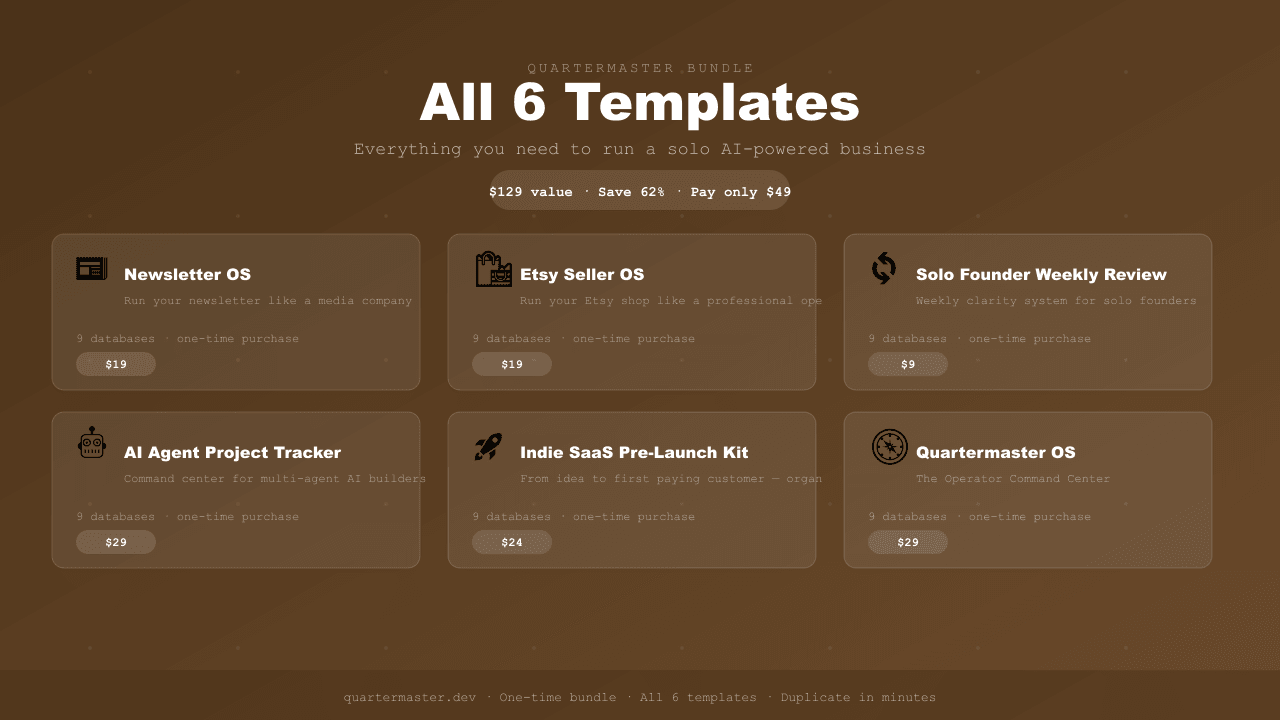
Quartermaster Bundle — all 6 Notion templates
Best Value

Quartermaster Bundle

All 6 Notion templates in one purchase. Quartermaster OS, Newsletter OS, Etsy Seller OS, Solo Founder Weekly Review, AI Agent Project Tracker, and Indie SaaS Pre-Launch Kit. Every workspace you need to run a solo operation.

$49 62% savings vs. buying all 6
Get the bundle ►
Quartermaster OS

9-database command center for solo operators running multiple businesses. Dashboard hub, AI prompts, revenue tracker, and more.

$29
Get template →
Newsletter OS

Issue planner, subscriber tracker, sponsor pipeline, growth metrics. Everything an indie newsletter writer needs in one workspace.

$19
Get template →
Etsy Seller OS

Listing tracker, profit per listing, tag/SEO library, custom order pipeline. Built for solo Etsy shops that want to scale without chaos.

$19
Get template →
Solo Founder Weekly Review

Weekly wins, blockers log, next week priorities, decisions made. A structured 30-minute ritual that keeps you on course.

$9
Get template →
AI Agent Project Tracker

Agent registry, prompts library, voyage log, cost tracker, eval results. Purpose-built for multi-agent builders shipping real products.

$29
Get template →
Indie SaaS Pre-Launch Kit

Waitlist, feedback inbox, MVP scope, launch checklist, competitor tracker. From idea to first paying customer, organized.

$24
Get template →